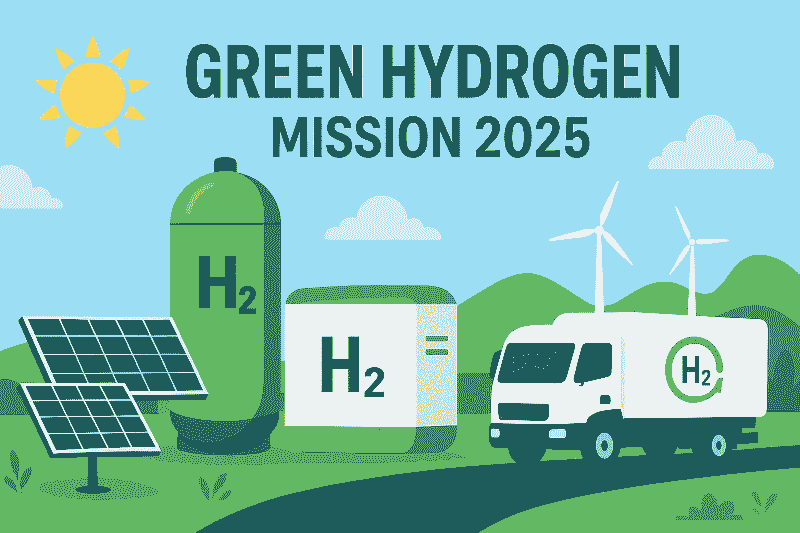
India has taken a historic step towards clean energy transformation. The Central Government has approved the “National Green Hydrogen Mission 2025”, aiming to establish India as a Global Green Energy Hub.
For this mission, the government has sanctioned a massive investment of ₹19,744 crore.
The primary goal of this initiative is to reduce India’s dependence on fossil fuels like coal, petrol, and diesel, and make the nation energy independent through clean and renewable energy sources.
What is Green Hydrogen and How Does It Work?
Green Hydrogen is a form of clean fuel that produces zero carbon emissions.
It is created by splitting water (H₂O) into hydrogen and oxygen using a process called electrolysis. The electricity used in this process comes from renewable sources like solar or wind power, making the hydrogen produced completely green and eco-friendly.
In Simple Terms:
Water → Hydrogen + Oxygen
(with the help of solar or wind energy)
No carbon dioxide (CO₂) is released in this process, making it highly effective in combating climate change and reducing greenhouse gas emissions.
Why Green Hydrogen is Important
Green Hydrogen is not just another energy source — it’s the core of the future sustainable energy revolution.
Its biggest advantage lies in being clean, renewable, and long-lasting, offering a permanent alternative to polluting fossil fuels.
Major Benefits:
- Zero Pollution: No harmful gases are emitted during production or use.
- Energy Independence: Reduces India’s dependence on imported oil and gas.
- Industrial Transformation: Can be used in steel, chemical, refinery, and transport sectors.
- Fuel Cell Vehicles: Hydrogen fuel cell cars are up to 60% more efficient than petrol vehicles.
Government’s Policy and ₹19,744 Crore Investment
The Government of India has sanctioned ₹19,744 crore for this mission.
This investment will strengthen technologies related to the production, storage, transportation, and utilization of green hydrogen.
The mission aims to achieve 5 million metric tonnes (MMT) of annual green hydrogen production by 2030.
Key Allocations:
-
₹17,490 crore – For Production Linked Incentives (PLI) and manufacturing support.
-
₹1,466 crore – For research, development, and new technology.
-
₹400 crore – For pilot projects and public awareness programs.
The policy also focuses on promoting export of green hydrogen, enabling India to play a leading role in the global green energy market.
Impact on Employment and Industry
The Green Hydrogen Mission is expected to generate a huge wave of new employment and industrial opportunities in India.
Experts estimate that more than 1 million (10 lakh) direct and indirect jobs could be created in the coming years.
Sectors That Will Benefit the Most:
- Manufacturing and Technical Work: Hydrogen plants, pipelines, and storage facilities.
- Research and Innovation: Development of eco-friendly and cost-effective technologies.
- Transport Sector: Hydrogen-powered buses, trucks, and railway engines.
- Energy Sector: Green hydrogen-based power generation and grid stabilization solutions.
This will also open career opportunities for Indian youth in the fast-growing green technology industry.
India’s Renewable Energy Vision 2030
India’s Renewable Energy Policy 2025 and National Green Hydrogen Mission together aim to help the nation achieve its Net Zero Emission target by 2070.
Currently, India is one of the world’s largest producers of solar energy, and this new initiative will further strengthen its position as a Global Clean Energy Leader.
Government’s Vision:
-
By 2030, renewable energy should contribute over 40% of India’s total energy consumption.
-
India will emerge as a major Hydrogen Export Hub.
-
Key industries will transition from fossil fuels to hydrogen-based systems.
Challenges and Solutions
Despite its ambitious goals, the mission faces a few challenges:
-
High Production Cost: Green hydrogen is still more expensive than traditional fuels.
-
Infrastructure Gaps: Safe storage and transportation of hydrogen require advanced facilities.
-
Skill and Technology Development: India needs more trained professionals and technical expertise in this domain.
However, the government and private sector are working together to overcome these challenges through Research & Development (R&D) and Public-Private Partnerships (PPP).
These collaborations are expected to reduce production costs and expand the use of green hydrogen across industries in the next few years.
A New Chapter in India’s Green Energy Journey
India has already launched several global initiatives like the International Solar Alliance (ISA) and One Sun One World One Grid (OSOWOG).
Now, the Green Hydrogen Mission India 2025 will take these efforts to the next level.
This mission will not only promote environmental protection but also strengthen energy security and economic growth for India’s sustainable future.
Conclusion
The National Green Hydrogen Mission 2025 is more than just a government initiative — it is India’s commitment to a greener and cleaner future.
With an investment of ₹19,744 crore, India is paving the way for a sustainable and energy-independent nation.
If successfully implemented, this mission could make India the world’s largest producer of green hydrogen by 2030, transforming the country from Energy Dependent to Energy Independent — a truly historic milestone.